Sunday, March 15, 2009, 08:22 PM - log
The German publisher 'Gestalten' has an entry on Packet Garden in their recent book Data Flow which looks at the visual culture and divergent practices surrounding information visualisation.
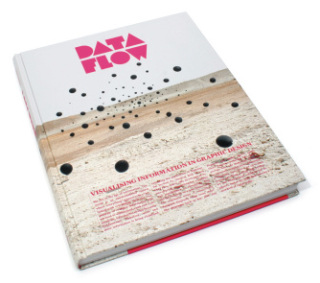
In other news the Swiss Arts Council commissioned a text from me on Art and Videogames for a publication called 'Swiss Design in Hollywood'. Here's the English version of the text that appears in the book (in French, Spanish and English - the latter version was heavily truncated). Here's the book itself:

The book is designed to accompany an exhibition of the same name, curated by Patrick J. Gyger, Director of Maison d'Ailleurs the museum of Science Fiction, Utopias and Extraordinary Journeys in Yverdon, Switzerland. Maison d'Ailleurs is well worth a visit by the way, truly an astonishing and beautifully designed museum. An archive that ought to be given room on any Ark of human culture and thought..
So it followed that Marta (check out her new book!) and I went to Valencia to visit Patrick who was opening the exhibition there. It had some great prints by illustrators John Howe, Christian L. Scheurer, Deak Ferrand, Natasha Devaud, Nicolas Imhof, Brigitte Wuest, Silvio Aebischer, Simon Christen, Nadja Bonacina, Simon Otto si Alex Ongaro.
John Howe, concept artist behind a great deal of films and games, was present at the opening. Talking with him - when he wasn't autographing a stream of books - was a rare treat and I look forward to our next meeting indeed..
| permalink
Friday, February 27, 2009, 02:54 AM - log
I've posted footage of PacketGarden for those that have never seen it running. You can see it on Vimeo here. Worth mentioning I'll gladly take any help I can get porting it to current versions of those other operating systems (OS X Intel and Windows Vista)!
Thursday, February 26, 2009, 08:10 PM - log
8 countries and 30 planes later.. i'm far too lazy to write a travelogue!
anyway, let this post signify my good intention to touch this page more often.
Wednesday, September 24, 2008, 05:32 PM - log
Last night I gave my lecture Cartofictions: Maps, The Imaginary and Geo-Social Engineering to a surprisingly well-attended room here at Mama, Zagreb. The talk went better than the 1.2h talk at Inclusiva-net 7 months ago (video documentation here), largely because I hadn't run amok the night before.
After the talk several people asked to see my slides and so I've made them available. You can get them here as a PDF. The folk at Mama said they'll make the audio available at some point. I'll keep you posted.
Tuesday, August 26, 2008, 01:22 AM - log
Hell hath no fury like a man whose laptop was recently stolen, while eating a delicious breakfast, by very clever thieves.
To cut a short story long, the $US is weak against the Euro and I need a new laptop fast, specifically the new Thinkpad T400: the ideal horse for this goucho.
If you're coming to Ars Electronica and want to make some fast money, email me and I can offer you a handsome cash incentive for buying me a laptop and bringing it with you, unboxed. Yes that's right, I just used the words "handsome cash incentive" and "fast money" on the Internet.
Oh, and if you've sent me an email at all since January this year, send it to me again..
Saturday, August 23, 2008, 04:40 AM - log
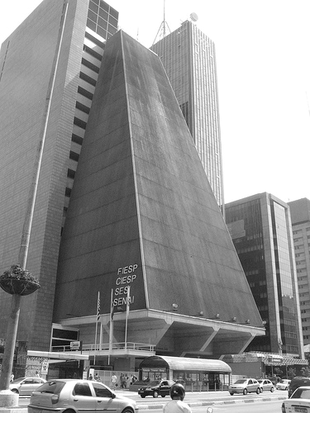 FILE2008 in Sao Paulo was super. Rarely do I meet such an attentive and genuinely interested team responsible for putting an exhibition together. The tech-crew were really on-to-it and the assistants hanging out with the pieces, explaining them to people, were too: they had about 1.5k people come through one Saturday. That requires a lot of patience.
 The interior design of the show was clever as were the curatorial choices overall. Anyway, FILE team, here's my belated thanks. Vivian, Paula and Daniel especially. Your festival rivals anything of its size in Europe..
Sao Paulo. Where to start - even a Paulista would ask the same. It's very diverse, at times rough, vast and complex. 20 Million humans trying to make it work in the metropolitan area (within a violently maldistributed economy) of which I met around 37. Despite being a hard-working, hard-living creed, Paulistas are socially generous; it's not a myth you can simply walk into a bar and smile your way into a fine night out.
That said, my dubious companion for most of it wasn't a Paulista. Rather, it was a certain James Powderly, ever ripe for some good old-fashioned silliness. Here's to you James. Haven't heard from you for a few days. Like many I hope you turn up soon. You were half-expecting to get shot. Let's hope my "not a foreigner and not during the games" theory stands up to your fairly respectable test ;)
A fine friend of mine Mariana hooked James up with some local writers/graffers so much time was spent with a generator, projector, laptop, camera and a laser-pointer around town at night. I learnt a lot about Pichação, the name given to a kind of street-writing that at times resembles Egyptian Hieroglyphs and is unique to Brazil (AFAIK). Each has it's own unique symbolic alphabet relative to clans. Mariana, was good to hang out with you and Lelo. Both talented and super people...
Friday, July 18, 2008, 07:06 PM - log
I've just cleaned up and archived documentation of Quilted Thought Organ, a sound-based game/performance environment I made in 1999, here. Yes the link to the movie works now.. Ugh. Thursday, June 19, 2008, 04:53 PM - log
levelHead received an Honorary Mention in the Interactive Arts category at Ars Electronica this year.
Apparently it will also be on show at the Ars Electronica Centre in September.
Thankyou jury!
Friday, March 14, 2008, 06:00 PM - log
Here's a video of my Inclusiva-Net Conference, Cartofictions: Maps, The Imaginary and GeoSocial Engineering. It's around an hour long. Note that it has one or two mis-placed slides at around 34mins. This aside the editor did quite a good job.
Abstract:
From the earliest world maps to Google Earth, cartography has been a vital interface to the world. It guides our perceptions of what the world is and steers our actions in it. As our knowledge about the world has changed, so have maps with it (or so we like to think).
In this lecture Julian shows a darker side of map-making, covering various reality-distorting effects innate to the graphic language of cartography and how they can be easily exploited for gain.. In doing so Julian positions cartography as an abstract and influentual creative practice, rich with the power to engineer political views, religious ideas and even the material world itself.
Enjoy!
Be sure to check out some of the excellent projects that came out of Inclusiva-Net this year - super stuff ppl, it was a pleasure
Big thanks to the Medialab-prado team for making it all happen.
Thursday, February 28, 2008, 08:29 PM - log
.. that's the name of my latest paper, prepared for the Homo Ludens Ludens conference at Laboral, Gijon, Spain in mid April. It'll be published in the symposium book alongside the work of this esteemed bunch.
Download it here. You're free to reproduce and distribute it under the terms of the Creative Commons Attribution 2.0 License.
Out of interest I'd prefer to use a license like the GNU Free Documentation License for my papers but I can't find anything that comes close while remaining suitable to theory.
If you have any ideas I'd be glad to have an email from you.
Wednesday, January 23, 2008, 03:57 PM - log

This is a project I've been dreaming up for a while. Only until recently however have developments in both computer vision and mobile hardware platforms made it possible to produce.
Here's the blurb:
The Artvertiser is a computer vision project exploring live, locational substitution of advertising content for the purposes of exhibiting digital artwork.
The Artvertiser takes Puerta del Sol Madrid, Times Square New York, Shibuya Tokyo and other sites dense with advertisements as exhibition space. The Artvertiser is an instrument of conversion and reclamation, taking imagery seen by millions and re-purposing it as a surface for presentation of art.
By 'training' a computer to recognize billboard advertisements, logos and other images of commerce, that content can then be 'replaced' with alternative material when seen through a specially engineered digital video device. If an internet connection is present at the site, it can be documented and published in on line galleries such as Flickr and YouTube.
So far the software component is coming along well. It is already possible to perform live substitution of billboards with images, 3D models or movies when seen through a sufficiently good camera. To get this far I've written a C++ application ontop of the excellent image tracking library Bazar that supports substituting the detected image with an OpenGL surface upon which I can draw video (live or from file) or static imagery.
Working with Clara Boj and Diego Diaz - also competent practitioners in Augmented Reality - I hope we can add a network component such that when an 'artvert' is seen in the wild it can be published to Flickr and/or filmed and uploaded to YouTube and similar video hosting services.
Soon I hope to upload videos of early trials of the system out in the wild.
Tuesday, January 1, 2008, 06:41 PM - log
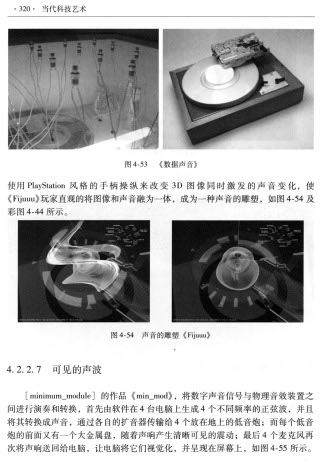
Name: Contemporary Art of Science and TechnologyISBN: 978-7-03-020415-8
Press name: Science Press
Language: Chinese
660 pages (62 pages in color)
We're on pages 319 and 320 next to a couple of great works. Here's a scan the editor was kind enough to send us:
.. and here's a scan of the cover:

Sunday, December 9, 2007, 12:49 PM - log
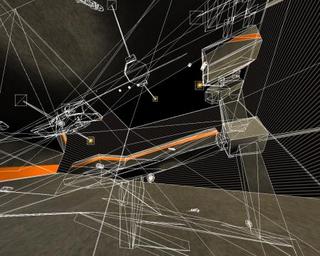
The q3apd project has been properly archived, with the inclusion of the LoveBytes06 Festival video documentation and galleries, here.
Friday, December 7, 2007, 02:37 PM - log
Hyperform Net Gallery has been kind enough to make me Artist of the Month for December 07, focussing on levelHead. Big thanks to all those involved at Hyperform.
Friday, December 7, 2007, 10:35 AM - log
Jean Poole was commissioned by Arnolfini to write on one or two aspects of my work over the years. Here's the text.
Thankyou Jean!
Saturday, November 10, 2007, 04:55 PM - log
Here's a manual I wrote introducing the basics of modeling, texturing and rendering using the excellent open-source software Blender for the FLOSSManuals project.
Later on I'll post a section on the Realtime Game Engine part of Blender toward the ends of rapidly prototyping game/3D interface ideas.
If you're interested in translating this manual into languages other than Dutch (Walter Langelaar is working on that) pls get in touch!
Monday, July 24, 2006, 06:08 PM - log
The slightly unweildy title is "
Buffering Bergson: Matter and Memory in 3D Games, soon to be published in a collection of essays called 'Emerging Small Tech' by The University of Minnesota Press.
The paper was actually written some time ago and I've been meaning to upload papers I've written to this blog. Let this be the first.
Sunday, July 9, 2006, 04:43 PM - log
For those of you that weren't there, here are the lecture notes, in HTML, of the first half of my day-class at the FAMU in Prague. Thanks to CIANT and to the students for a fun and productive day.
Tuesday, June 27, 2006, 12:45 AM - log
many of you have written to me about the Blender --> PureData HOWTO i wrote up last year and how you've used it in your own projects. it's great to see this simple tute forming the basis of a few workshops and university classes now also (here's looking at you Andy!).it seems the Wiretap site is currently down - and has been for a while. for this reason you'll probably be missing an essential ingredient of the tutorial, the pyKit Python -> OSC interface libraries.
because i'm very nice, i've archived them here until they're back online.
Friday, November 25, 2005, 10:20 PM - log
I've been meaning to put these up for a while: documents of experiments in the extents of the Ogre3D material framework, pix's 'OgreOSC' implementation and particle systems (both his and the native Ogre3D PS) while working on the TRG project. This was all done around a year ago now, preserved here for some semblance of posterity. Ogre3D has since grown alot and is currently serving as the basis for the next generation of the fijuu project. Examples below using OSC were driven with PD as the control interface.material-skin A demo using wave_xform to manipulate textures to an oscillation pattern across two dimensions whose periods are out of phase. The material is scrolled across a static convolved mesh creating interference patterns.
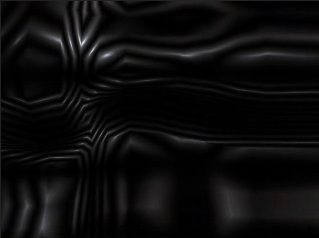
The syntax is simplistic and easy to work with. Here's an example as used for the above movie:
material tmp/xform

{

    technique

    {

            pass

            {

                    scene_blend add

                    depth_write off

                     texture_unit

                    {

                            texture some.png

                            wave_xform scroll_x sine 1.0 0.02 0.0 0.5

                            wave_xform rotate sine 0.0 0.02 0.0 1.0

                            env_map planar

                    }

            }

      }

}
material-wine The same as above, but exploring alpha layers and some new blend modes
particle-glint A short life particle system using native ogre particle functions. Linear force along y causes particles to rise up as they expire while new particles are seeded within fixed bounds below.
particle-hair Altering the particle length and using colour blending to give the effect of hair/rays.
particle-horiz Another version of above. reasonably pointless.
particle-hair2 Hair effect with more body 'n' shine.
particle-bloom a remix of pix's swarm effect using a few blend modes, force affectors and some texture processing.
particle-bloempje another remix of pix's swarm effect.
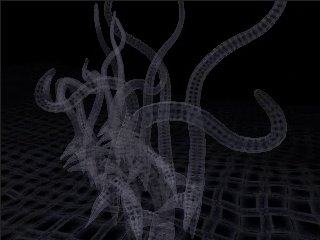
techno-tentacle example of using OSC to drive animation tracks. Here pitch analysis on an arbitrary audio track is passed to OSC which then controls playback period and mix weights between two armature animation tracks. Tentacles dance around as though Pixar was paying me. The tentacle has about 30 bones and has been instantiated 12 times in the scene. Individual control is possible as are the use of more animation tracks.
animated-textures basic example of animated textures in use.
animated-textures-LSCM another example of animated textures in use but on a mesh of 382 faces. the mesh has been LSCM unwrapped to create 'seamless' UV coords.