Friday, February 27, 2009, 02:54 AM - log
I've posted footage of PacketGarden for those that have never seen it running. You can see it on Vimeo here. Worth mentioning I'll gladly take any help I can get porting it to current versions of those other operating systems (OS X Intel and Windows Vista)!
| permalink
Thursday, February 26, 2009, 08:22 PM - dev

I've made good progress on The Artvertiser software, with several live tests out in the field proving to be successful. Clara and Diego are working on the hardware, and to those ends we've ordered a couple of Beagle Boards for the handheld device (binoculars).
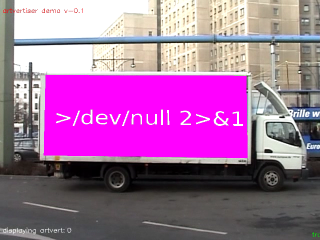
Here are a couple of videos of recent field tests:
Callao, Madrid, 18M AVI
Heinrich Heine Platz, Berlin, 16M AVI
Alexander Platz, Berlin, 51M AVI
Nokia and Google, if you're reading, feel free to send me some hardware so I can target your platforms (Nokia, your N96 and Google, an HTC Magic +/or Texas Instruments OMAP34x-II MDP Zoom w/Android would be lovely. TY!)..
Thursday, February 26, 2009, 08:10 PM - log
8 countries and 30 planes later.. i'm far too lazy to write a travelogue!
anyway, let this post signify my good intention to touch this page more often.
Wednesday, September 24, 2008, 05:32 PM - log
Last night I gave my lecture Cartofictions: Maps, The Imaginary and Geo-Social Engineering to a surprisingly well-attended room here at Mama, Zagreb. The talk went better than the 1.2h talk at Inclusiva-net 7 months ago (video documentation here), largely because I hadn't run amok the night before.
After the talk several people asked to see my slides and so I've made them available. You can get them here as a PDF. The folk at Mama said they'll make the audio available at some point. I'll keep you posted.
Tuesday, August 26, 2008, 01:22 AM - log
Hell hath no fury like a man whose laptop was recently stolen, while eating a delicious breakfast, by very clever thieves.
To cut a short story long, the $US is weak against the Euro and I need a new laptop fast, specifically the new Thinkpad T400: the ideal horse for this goucho.
If you're coming to Ars Electronica and want to make some fast money, email me and I can offer you a handsome cash incentive for buying me a laptop and bringing it with you, unboxed. Yes that's right, I just used the words "handsome cash incentive" and "fast money" on the Internet.
Oh, and if you've sent me an email at all since January this year, send it to me again..
Saturday, August 23, 2008, 04:40 AM - log
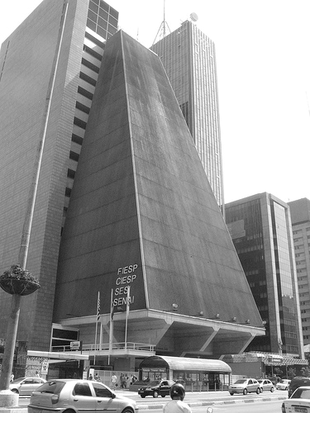 FILE2008 in Sao Paulo was super. Rarely do I meet such an attentive and genuinely interested team responsible for putting an exhibition together. The tech-crew were really on-to-it and the assistants hanging out with the pieces, explaining them to people, were too: they had about 1.5k people come through one Saturday. That requires a lot of patience.
 The interior design of the show was clever as were the curatorial choices overall. Anyway, FILE team, here's my belated thanks. Vivian, Paula and Daniel especially. Your festival rivals anything of its size in Europe..
Sao Paulo. Where to start - even a Paulista would ask the same. It's very diverse, at times rough, vast and complex. 20 Million humans trying to make it work in the metropolitan area (within a violently maldistributed economy) of which I met around 37. Despite being a hard-working, hard-living creed, Paulistas are socially generous; it's not a myth you can simply walk into a bar and smile your way into a fine night out.
That said, my dubious companion for most of it wasn't a Paulista. Rather, it was a certain James Powderly, ever ripe for some good old-fashioned silliness. Here's to you James. Haven't heard from you for a few days. Like many I hope you turn up soon. You were half-expecting to get shot. Let's hope my "not a foreigner and not during the games" theory stands up to your fairly respectable test ;)
A fine friend of mine Mariana hooked James up with some local writers/graffers so much time was spent with a generator, projector, laptop, camera and a laser-pointer around town at night. I learnt a lot about Pichação, the name given to a kind of street-writing that at times resembles Egyptian Hieroglyphs and is unique to Brazil (AFAIK). Each has it's own unique symbolic alphabet relative to clans. Mariana, was good to hang out with you and Lelo. Both talented and super people...
Wednesday, July 30, 2008, 09:10 AM - live
After many requests and a heap of delays the levelHead source code is now publically available under the General Public License V3.0. All art assets are provided under the CC-BY-SA 3.0 license. See this install page for full instructions.
This is a release intended for developers and those comfortable with the compiling software on Linux systems. As yet there is no binary executable of levelHead.
More about that soon..
Tuesday, July 29, 2008, 01:12 PM - live
 I'm off to Sao Paulo, Brazil tomorrow for the FILE festival to install levelHead.
Let it be known i'm currently looking for reccommendations of good vegetarian restaurants..
Friday, July 18, 2008, 07:06 PM - log
I've just cleaned up and archived documentation of Quilted Thought Organ, a sound-based game/performance environment I made in 1999, here. Yes the link to the movie works now.. Ugh. Monday, July 14, 2008, 01:29 AM - howtos
While I prefer the operating system Debian for development and general computery tasks, I use Ubuntu for art installations. From my experience Ubuntu has a great track record with diverse hardware and is a reliable performer with recent versions of free software. 30 minutes and you're up and running in most cases.
One great frustration with Ubuntu in a gallery/museum context however (may be fixed in 8.04) is the aggressive screen-blanking. For whatever reason disabling gnome-screensaver and various other power-management settings relating to the screen doesn't discourage it from blanking. Yes, asking the assistant of the piece to wiggle the mouse every 20 minutes is a pretty rubbish workaround..
So, here's how to permanently disable screen blanking under X on Ubuntu (and probably any other distribution). Pop this in your
/etc/X11/xorg.conf and restart X
Section "ServerFlags"

 Option "BlankTime" "0"

 Option "StandbyTime" "0"

 Option "SuspendTime" "0"

 Option "OffTime" "0"

EndSection
It's the little things..
Found here.
Friday, July 11, 2008, 01:38 PM - live
This, the first footage of the first stable version of levelHead, was documented yesterday with a speed-run of 227 seconds ;) through the first 3 cubes.
Aside from the above Vimeo documentation, you can download the 65M OGG/Theora file here. It will play in VLC.
This video was made thanks to Blender's great new video sequence editor (finally a fast and stable Free video editor for Linux) and captured using the strangely performant 3d desktop video capture solution for Linux Bugle.
For those of you keen to get your hands on the code: it's coming soon! I still need to tidy up the literature before it ships..
Monday, July 7, 2008, 02:54 PM - dev
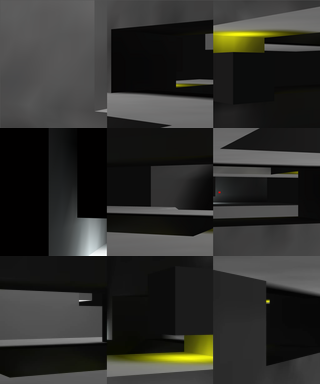
I've documented 2 'software triptyches' I made in 2006, and one I recently finished, here.
Enjoy.
Thursday, June 19, 2008, 04:53 PM - log
levelHead received an Honorary Mention in the Interactive Arts category at Ars Electronica this year.
Apparently it will also be on show at the Ars Electronica Centre in September.
Thankyou jury!
Friday, May 23, 2008, 06:00 PM - live
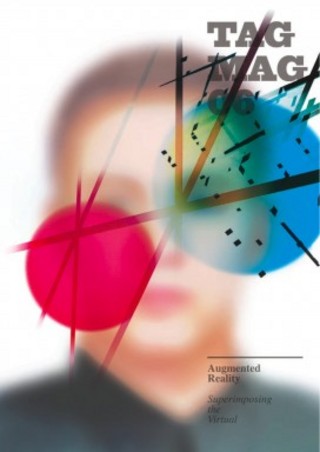
I recently gave an interview for TAGMAG 6 as part of their feature on Augmented Reality. It's quite an interesting issue surveying AR from a cultural, philosphical and artistic perspective.
Get it here
If you're in Den Haag region come to TAG<> and play the best version of levelHead yet alongside some great work by other aritsts like Theo Watson and Jan Torpus.
Monday, April 21, 2008, 05:44 PM - live
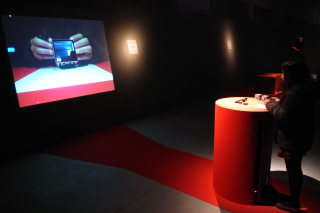
As promised, here's a gallery of images of levelHead in action on day 2 of Homo Ludens Ludens. As you can see they were taken by a far better photographer, utilizing a special feature of the camera known as 'autofocus'..
Sunday, April 20, 2008, 12:13 AM - live
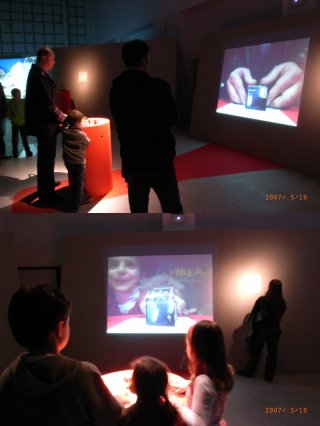
Last night at the opening was the first time levelHead has been seen in the wild. As such it's been extremely revealing watching people play it, something I've done for a few hours today.
The response has been very enthusiastic and almost all people seem to 'get' the interface pretty much immediately (with the exception of one woman using the camera to explore her nostrils on the projection at a rather inopportune moment).
That aside I'm surprised at the breadth of variance in the capacity of people to record and recall information about the room they were last in. Of the 50 or 60 people I watched play levelHead, I twice saw people demonstrate alien-savant powers in this regard, completing the first cube in under 2 minutes. Almost everyone I watched took their capacity to navigate effectively quite personally, even at times stopping to make mental notes before moving to a connecting room.
One thing I'm greatly enjoying about this piece is the ever presence of hands, made gigantic, carefully holding the cube complete with little world inside.
Aside from changing all the in-game dialogues to Spanish, I'm clear on the few tweaks I'll make for SonarMatica at Sonar08 in June. One thing is certain, the cubes will need to be an extremely durable plastic.
I've uploaded a little gallery of people playing on day 1 of Homo Ludens Ludens, one that expresses most of all just how little I understand our new Ricoh GR Digital camera (or perhaps photography in general). I'll make another one of people playing tomorrow on return home.
Monday, April 14, 2008, 12:56 PM - dev
It's been a good couple of weeks working on levelHead, in preparation for the Homo Ludens Ludens (aka "Man, the player") exhibition at LABoral, Gijon, Asturias, Spain.
The controls are far more robust and a great many bugs have been slayed (in a caring and respectful way). There are now 3 playable levels and a bunch of user-notications and other goodies that aid navigation.
At the 11th hour pix came on board to migrate the tracker from ARToolkit to ARToolkitPlus, which has worked splendidly: tracker stability is far better than it was with my previous ARToolkit implementation.
While working together he chose to go on a bug hunt, chasing in particular a graphic glitch where two rooms were being drawn at the same time. I'd written the first version with the intention of just one room being drawn at a time (one marker to be tracked for simplicity) but with the aid of a stencil-buffer he managed to make the use of the likely occurence that two or even three rooms can be seen at once:
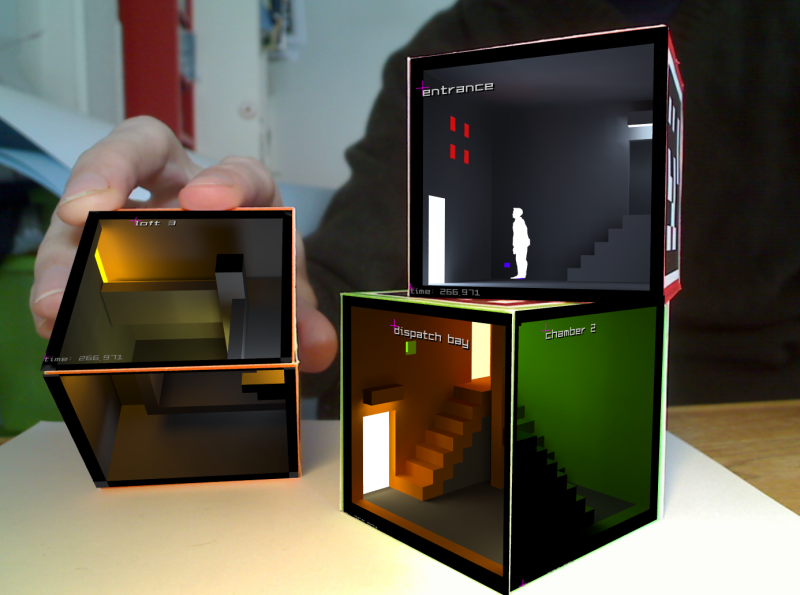
Development hasn't all been in code, I also have some lovely new cubes:
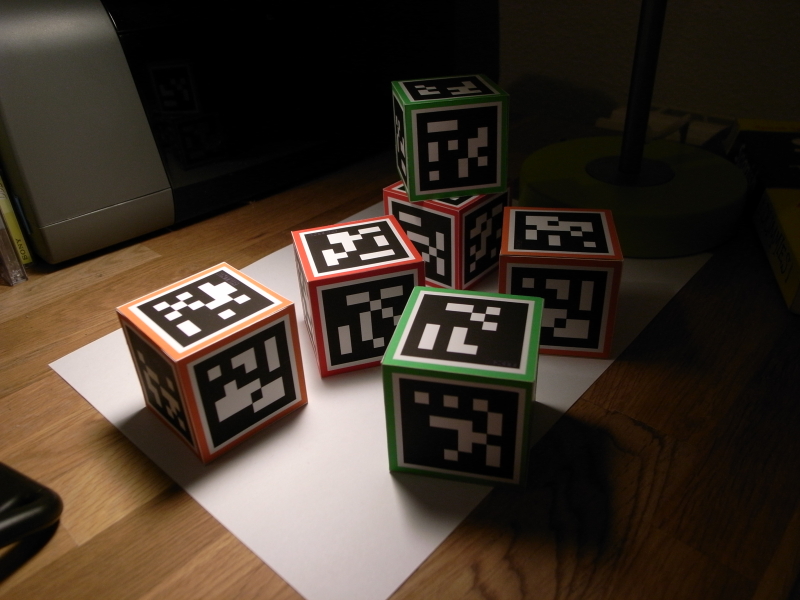
So at the end of a fairly fierce two weeks of programming, levelHead is ready to be unleashed on the Asturians, where it will be installed for 5 months. For those that can't make it to Gijon, levelHead will next be exhibited at Sonar, Barcelona this year.
More about that later.
Friday, March 14, 2008, 06:00 PM - log
Here's a video of my Inclusiva-Net Conference, Cartofictions: Maps, The Imaginary and GeoSocial Engineering. It's around an hour long. Note that it has one or two mis-placed slides at around 34mins. This aside the editor did quite a good job.
Abstract:
From the earliest world maps to Google Earth, cartography has been a vital interface to the world. It guides our perceptions of what the world is and steers our actions in it. As our knowledge about the world has changed, so have maps with it (or so we like to think).
In this lecture Julian shows a darker side of map-making, covering various reality-distorting effects innate to the graphic language of cartography and how they can be easily exploited for gain.. In doing so Julian positions cartography as an abstract and influentual creative practice, rich with the power to engineer political views, religious ideas and even the material world itself.
Enjoy!
Be sure to check out some of the excellent projects that came out of Inclusiva-Net this year - super stuff ppl, it was a pleasure
Big thanks to the Medialab-prado team for making it all happen.
Thursday, February 28, 2008, 08:29 PM - log
.. that's the name of my latest paper, prepared for the Homo Ludens Ludens conference at Laboral, Gijon, Spain in mid April. It'll be published in the symposium book alongside the work of this esteemed bunch.
Download it here. You're free to reproduce and distribute it under the terms of the Creative Commons Attribution 2.0 License.
Out of interest I'd prefer to use a license like the GNU Free Documentation License for my papers but I can't find anything that comes close while remaining suitable to theory.
If you have any ideas I'd be glad to have an email from you.
Wednesday, February 6, 2008, 10:54 PM - dev
More Artvertising..

The below two videos show basic live image substitution of a postcard, seen by my webcam.
This clip demonstrates playing a movie 'on' the postcard and this video demonstrates cycling through a variety of images while attempting to emulate the local lighting conditions.
It's still not as stable as I'd like but nonetheless it's getting there.
The idea, of course, isn't to substitute images on arbitrary postcards but on big billboards, bus-stops and sign advertising in cities. I do have a clip of a substitution of a road-side sign but it's a bit rubbish due to it being quite dark at the time.
As opposed to (most) other augmented reality techniques - which use specially designed black-and-white fiducial markers - here the image itself is the marker.. This is much more processor intensive than normal marker tracking.
Naturally I'd love to see this working on a mobile phone but having played with a Nokia N95 recently - perhaps the best-specc'd phone for this sort of work - it's clear that fast image detection is well beyond the scope of current phone hardware; at least at more than a few frames a second. That's not to say standard augmentation using fiducial markers doesn't work fine on such a phone (like those used with ARToolkitPlus)..
Nonetheless, a UMPC built into a pair of binoculars is probably a bit more fun out on the field anyway.
Wednesday, January 23, 2008, 03:57 PM - log

This is a project I've been dreaming up for a while. Only until recently however have developments in both computer vision and mobile hardware platforms made it possible to produce.
Here's the blurb:
The Artvertiser is a computer vision project exploring live, locational substitution of advertising content for the purposes of exhibiting digital artwork.
The Artvertiser takes Puerta del Sol Madrid, Times Square New York, Shibuya Tokyo and other sites dense with advertisements as exhibition space. The Artvertiser is an instrument of conversion and reclamation, taking imagery seen by millions and re-purposing it as a surface for presentation of art.
By 'training' a computer to recognize billboard advertisements, logos and other images of commerce, that content can then be 'replaced' with alternative material when seen through a specially engineered digital video device. If an internet connection is present at the site, it can be documented and published in on line galleries such as Flickr and YouTube.
So far the software component is coming along well. It is already possible to perform live substitution of billboards with images, 3D models or movies when seen through a sufficiently good camera. To get this far I've written a C++ application ontop of the excellent image tracking library Bazar that supports substituting the detected image with an OpenGL surface upon which I can draw video (live or from file) or static imagery.
Working with Clara Boj and Diego Diaz - also competent practitioners in Augmented Reality - I hope we can add a network component such that when an 'artvert' is seen in the wild it can be published to Flickr and/or filmed and uploaded to YouTube and similar video hosting services.
Soon I hope to upload videos of early trials of the system out in the wild.
Tuesday, January 1, 2008, 06:41 PM - log
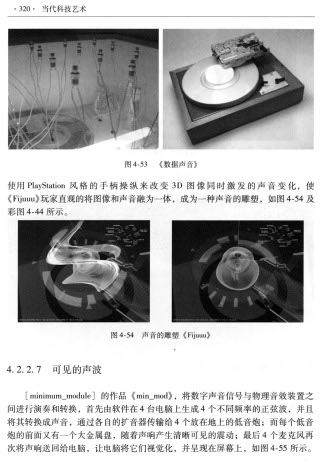
Name: Contemporary Art of Science and TechnologyISBN: 978-7-03-020415-8
Press name: Science Press
Language: Chinese
660 pages (62 pages in color)
We're on pages 319 and 320 next to a couple of great works. Here's a scan the editor was kind enough to send us:
.. and here's a scan of the cover:

Sunday, December 16, 2007, 03:31 PM - code
I recently spent some time looking around the hinternets for a simple method to stream live video, captured using OpenCV, from a webcam or firewire camera, to textures on one or more OpenGL polygons, windowed with something light like GLUT. Having found nothing that acheives this, and seeing that lots of people were trying, I wrote a program in C that does.
Why OpenCV? OpenCV offers advanced texture processing and analysis: being able to find natural features in images on OpenGL surfaces offers up many interesting possibilities.
The trick was just to pass correctly scaled (power of 2), captured IplImage data to glTexSubImage2D every frame. It needed to be correctly formatted and bound beforehand.
Get the source code here, licensed under the GPLv3. It will compile on a Linux system. OpenCV, FreeGlut and OpenGL are needed. You'll need hardware accelerated 3D too..
Enjoy!
Sunday, December 9, 2007, 12:49 PM - log
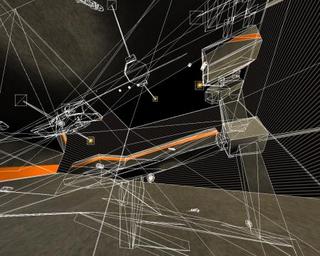
The q3apd project has been properly archived, with the inclusion of the LoveBytes06 Festival video documentation and galleries, here.
Friday, December 7, 2007, 02:37 PM - log
Hyperform Net Gallery has been kind enough to make me Artist of the Month for December 07, focussing on levelHead. Big thanks to all those involved at Hyperform.
Friday, December 7, 2007, 10:35 AM - log
Jean Poole was commissioned by Arnolfini to write on one or two aspects of my work over the years. Here's the text.
Thankyou Jean!
Saturday, November 10, 2007, 04:55 PM - log
Here's a manual I wrote introducing the basics of modeling, texturing and rendering using the excellent open-source software Blender for the FLOSSManuals project.
Later on I'll post a section on the Realtime Game Engine part of Blender toward the ends of rapidly prototyping game/3D interface ideas.
If you're interested in translating this manual into languages other than Dutch (Walter Langelaar is working on that) pls get in touch!
Monday, October 15, 2007, 06:25 PM - dev

I've just finished the first beta (really an alpha) of my little AR/tangible-interface game levelHead. Admittedly there's not much up on the project page yet, but here's a YouTube video that conveys the general idea pretty well. It still has glitches but i'll iron those out soon enough.
At some point i also want to look into the idea of using invisible markers (have a few promising possibilities there) or full colour picture markers (also possible, though requires much more CPU braun).

Here's a better quality video in the OGG/Theora format (plays in VLC).
Enjoy.
Thursday, August 2, 2007, 06:09 PM - dev
Here are packages of Packet Garden for Ubuntu 7.04.
To install just download, double-click and go. You might want to install dpkt and pycap first (also found at the above link).
Tuesday, July 31, 2007, 11:51 AM - live
next